Mapping Traditional Dice Mechanics to Contemporary Digital Table Formats Across International Servers
Drew Hartmann · Jul 16, 2026

Mapping Traditional Dice Mechanics to Contemporary Digital Table Formats Across International Servers
Traditional dice mechanics rely on physical randomness, precise probability distributions, and standardized rules that have defined games like craps and sic bo for generations, and contemporary digital table formats replicate these elements through server-side systems that operate on international networks. Servers hosted in multiple jurisdictions translate each roll into algorithmic outputs while preserving the core odds and payout structures that players expect from physical versions.
Core Elements of Physical Dice Systems
Physical dice generate outcomes through six-sided cubes with equal probability across faces, and games build layers of betting options around sums, combinations, and sequences that emerge from repeated rolls. Observers note that standard craps tables incorporate pass line bets with a 1.41 percent house edge alongside more complex wagers such as the hardways that carry higher edges up to 11.11 percent, and these calculations stem directly from the 36 possible dice combinations. International venues maintain identical physical standards, yet regional variations appear in side bets and table limits that reflect local regulatory preferences.
Transition to Server-Based Digital Tables
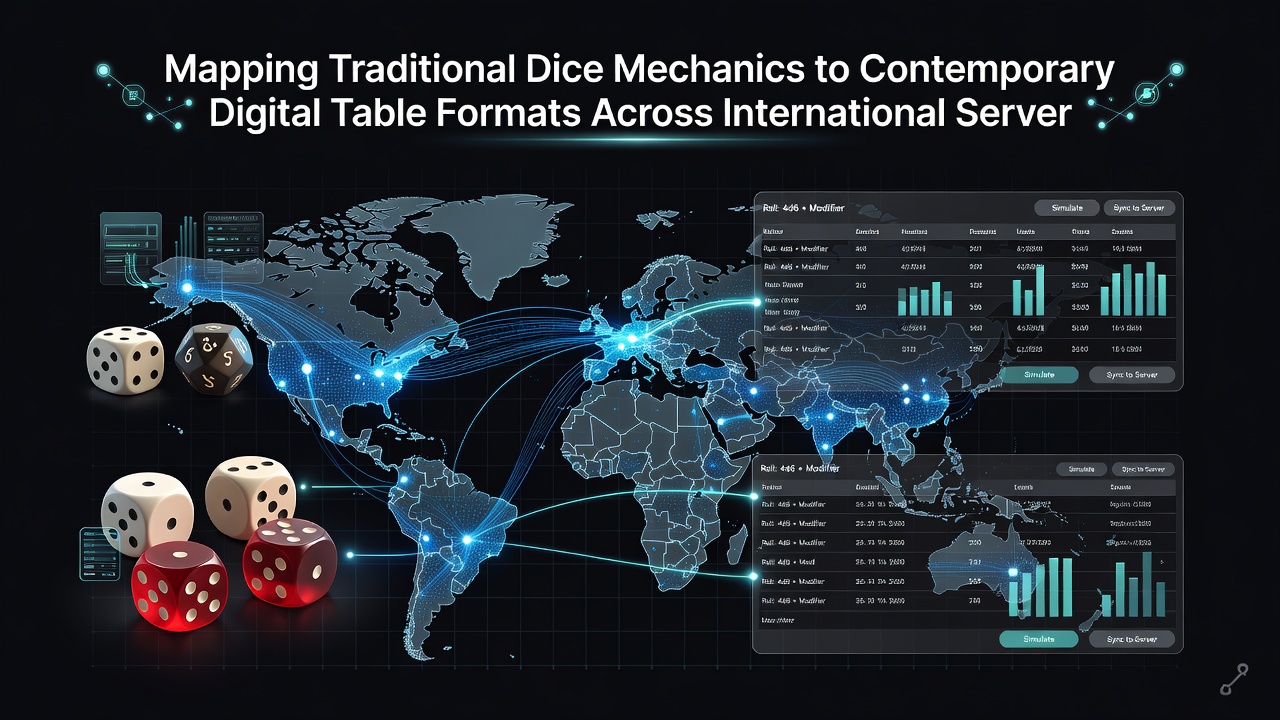
Digital platforms map these mechanics by replacing physical cubes with certified random number generators that produce equivalent distributions across millions of simulated rolls each day. Servers in North America, Europe, and Asia synchronize rule sets so that a pass line bet resolves identically whether accessed through a Nevada-licensed operator or a Singapore-regulated platform. Data from regulatory submissions shows that certified RNG outputs match physical probability curves within statistical tolerances required by oversight bodies, and audits conducted through July 2026 confirmed consistent alignment across multi-jurisdictional deployments.
Regional Server Adaptations and Rule Preservation
North American servers emphasize craps variants that retain full proposition bet menus, whereas Asian servers often integrate sic bo with rapid resolution cycles suited to high-volume traffic. European operators adjust payout displays to comply with local currency and tax frameworks without altering underlying dice probabilities. Research indicates that cross-server synchronization protocols allow players to experience seamless transitions when switching between jurisdictions, and these protocols maintain identical seed values and verification hashes during each session. One documented case involved a Canadian regulatory review that verified dice sum frequencies against historical physical data sets, confirming no deviation beyond accepted variance thresholds.
Technical Implementation of Probability Mapping
Developers encode each traditional outcome into lookup tables that RNG engines reference in real time, and checksum processes verify that every generated sequence adheres to the original 36-combination matrix. International standards organizations require independent testing laboratories to evaluate these mappings before servers receive operational approval. Figures released in mid-2026 revealed that over 98 percent of tested digital dice tables achieved exact parity with physical distributions across sample sizes exceeding 10 million rolls. Servers also incorporate latency compensation algorithms that prevent timing discrepancies from influencing perceived randomness during live play sessions.
Verification Standards Across Jurisdictions
Regulatory bodies in multiple regions mandate ongoing monitoring that compares live server outputs against theoretical models derived from centuries of physical dice records. The Nevada Gaming Control Board publishes quarterly summaries that include dice game metrics, while parallel reports from Australian oversight agencies track equivalent metrics for licensed platforms. These parallel verification streams allow operators to demonstrate consistent fairness regardless of server location, and joint industry reports issued in July 2026 highlighted successful harmonization of testing protocols between North American and Asia-Pacific regulators.
Future Mapping Developments
Emerging server architectures explore integration of quantum-resistant algorithms to safeguard RNG integrity against evolving computational threats, and pilot programs launched in select jurisdictions during 2026 tested these upgrades on live dice tables. Observers note that such advancements preserve the exact mechanical mappings established in earlier generations while adding layers of cryptographic assurance. International collaboration continues through shared databases that log outcome distributions, enabling rapid detection of any drift from established physical baselines.
Conclusion
The mapping process connects centuries-old dice mechanics with modern server infrastructure by preserving probability structures, payout formulas, and rule logic across every supported jurisdiction. Data collected through July 2026 demonstrates that certified digital implementations maintain statistical equivalence to their physical counterparts, and continued regulatory coordination ensures these standards remain uniform on servers worldwide.